


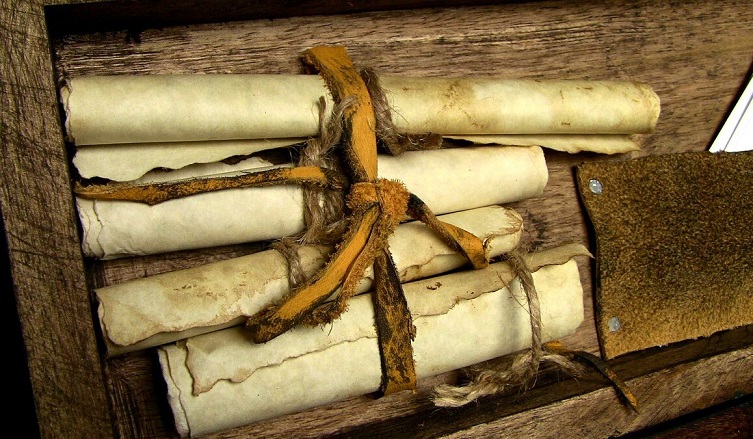
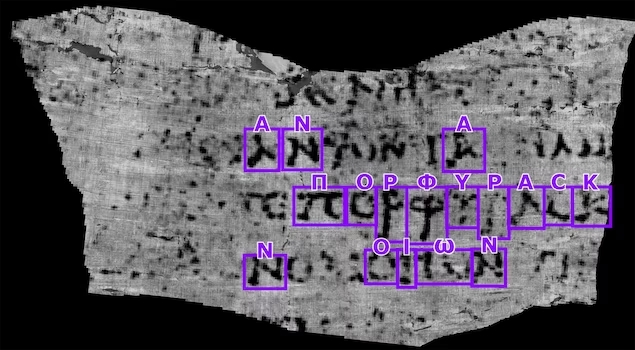
 The papyrus originates from the famous library in Herculaneum, which was buried under ash during the eruption of Mount Vesuvius in 79 AD, alongside Pompey. For more than two centuries, scholars have tried to decipher the remaining manuscripts from the library, but every attempt to physically open them destroys the fragile material.
One of the papyri, charred after the eruption of Mount Vesuvius and left unreadable for nearly 2,000 years, has finally revealed its secrets thanks to artificial intelligence, opening a new chapter in the study of ancient Greek philosophy.
The major breakthrough came from the “Vesuvius Challenge” program, which combines ultra-high-resolution 3D scans with artificial intelligence algorithms. For the first time, researchers managed to digitally “unroll” a papyrus without touching it, revealing about 1.5 meters of continuous text divided into 22 columns.
The content of the manuscript concerns matters of ethics and includes repeated references to Stoic philosophy. Experts believe the likely author is the ancient Greek philosopher Chrysippus—a leading figure of ancient Stoicism. He authored a large number of works—around 705 according to ancient sources—though the content of none had survived to our day.
If the authorship of the deciphered text is confirmed, it would be one of the most important literary discoveries in recent decades.
Meanwhile, researchers have also identified a second papyrus—the treatise “On Gods, Book 8” by the Epicurean philosopher Philodemus—which turned out to be much larger than previously thought.
Scientists suspect there are hundreds more papyri from the library that still remain sealed. If new technologies continue to develop in this direction, there is a chance in the coming years that we will learn about other ancient philosophical texts once thought to be completely lost, telling us more about the ideas of their authors, whom we have known until now only from fragments or references in other works.
The text is based on materials from the Greek publication Μικροπράγματα (Lifo).


